


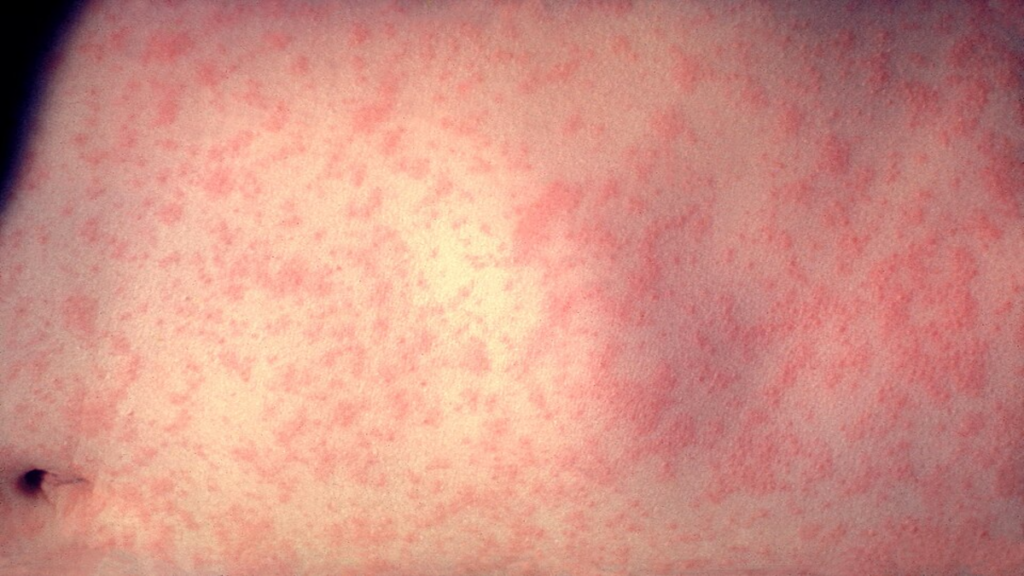
More than 1,100 people have contracted measles across Pennsylvania in 2026, with hundreds hospitalized. State health officials are investigating another possible fatality while federal authorities prepare additional assistance.
By A.T.L. N.E.W.S. Staff | October 13, 2026
PENNSYLVANIA NEWS | HEALTH & PUBLIC SAFETY
HARRISBURG, Pa. — Pennsylvania is confronting one of its most serious measles outbreaks in decades, with five deaths confirmed by state health authorities, more than 1,100 reported infections and a sixth possible fatality now under investigation.
The latest development follows the death of a 39-year-old woman in Franklin County who had contracted measles and was being treated for the disease. Local authorities reported the death on October 12, raising the possibility that Pennsylvania’s measles-associated death toll could increase to six.
The Pennsylvania Department of Health is reviewing that death to determine whether it meets the state’s criteria for inclusion in the official outbreak statistics. Until that review is completed, the state-confirmed toll remains five, although the Franklin County death has been reported as measles-associated by local authorities.
The outbreak has spread across much of the commonwealth since emerging in late April, prompting expanded vaccination efforts, emergency response measures and growing concern about declining immunization rates.
According to Reuters, Pennsylvania health officials have confirmed five deaths since August, while the newly reported Franklin County fatality remains under review.
An outbreak spreading across Pennsylvania
Pennsylvania measles outbreak — reported figures
1,136
Reported cases as of Oct. 9
5
State-confirmed associated deaths
219
Reported hospitalizations as of Oct. 13
1
Additional death under review
Figures are reported at different cutoff dates. Hospitalization data are from October 13 reporting; the confirmed death count excludes the pending Franklin County review.
The outbreak has grown substantially since the beginning of September, when Pennsylvania was reporting several hundred infections. By September 30, the Department of Health had documented 943 cases across 39 counties and 176 hospitalizations.
Within days, the number surpassed 1,000. By October 9, the commonwealth had recorded 1,136 cases, demonstrating the continuing spread of a disease that had been largely absent from Pennsylvania for decades.
Lancaster County has been a major center of the outbreak, although infections have been reported across rural, suburban and urban communities.
Measles is an extremely contagious respiratory disease that spreads through the air when an infected person breathes, coughs or sneezes. Its ability to remain airborne in enclosed spaces makes outbreaks especially concerning in schools, healthcare facilities, childcare centers and other places where people gather.
The Pennsylvania Department of Health has encouraged residents to check their vaccination status and use its public measles dashboard to follow outbreaks in their communities.
Five deaths include two infants and young adults
The deaths reported by Pennsylvania have underscored the dangers measles can pose to vulnerable populations, particularly infants who are too young to receive their routine first vaccination.
Among the five people identified through state and local reporting were a newborn and a six-week-old infant in Lancaster County, an 18-year-old in Mifflin County and a 40-year-old woman in Jefferson County. The fifth fatality involved another unvaccinated Lancaster County resident whose age and identifying details were withheld to protect the family’s privacy.
The 18-year-old reportedly developed acute disseminated encephalomyelitis, a rare but serious inflammatory neurological complication associated with infections, including measles.
Pennsylvania’s first two deaths were announced on August 25, marking the state’s first measles-associated fatalities in 35 years. Two additional deaths were confirmed in September before the fifth was announced at the end of that month.
The American Academy of Pediatrics documented the deaths and highlighted the particularly serious risks to unvaccinated people and infants too young to be protected through routine immunization.
Sixth possible death raises further concerns
The latest suspected fatality involves a 39-year-old woman from Franklin County who had previously been diagnosed and treated for measles.
According to the county coroner’s reporting, the woman had several underlying medical conditions, and her death may have involved an acute cardiac event associated with complications following her illness.
Pennsylvania health officials are evaluating the circumstances before determining whether to add her death to the state’s confirmed count.
The distinction between a death occurring after measles infection and one directly caused by the disease is an important part of public health surveillance. Some infected patients may have additional medical conditions that complicate the determination of whether the infection caused or contributed to their deaths.
The Franklin County investigation follows similar scrutiny of how measles-associated fatalities are classified across the United States.
Federal and state authorities disagree over death classifications
The outbreak has also exposed differences between Pennsylvania’s reported measles-associated death figures and the numbers published by the Centers for Disease Control and Prevention.
Although Pennsylvania has confirmed five deaths under its own surveillance criteria, federal authorities have listed only two measles deaths nationwide for 2026, without publicly identifying their locations.
The discrepancy involves differences in how deaths are reported, evaluated and incorporated into national mortality statistics. Pennsylvania’s approach counts deaths meeting its measles-associated criteria, while federal reporting has relied on a separate process involving national death records.
The disagreement has drawn the attention of Pennsylvania Governor Josh Shapiro and federal health officials as the state continues requesting additional assistance to control the outbreak.
On October 13, the CDC announced plans to deploy additional resources to Pennsylvania to help investigate and contain the spread of measles.
The agency’s involvement comes as health departments nationwide confront a resurgence of the disease after years of comparatively limited transmission.
Pennsylvania expands vaccination and prevention efforts
State health officials have accelerated vaccination efforts through temporary clinics, community outreach and partnerships with local healthcare providers.
During September, more than 53,000 doses of the measles, mumps and rubella (MMR) vaccine were administered statewide, more than twice the amount typically administered during that month.
Pennsylvania also established pop-up vaccination clinics in affected communities, including areas experiencing high rates of transmission.
The MMR vaccine remains one of the most effective methods of preventing measles. According to the CDC’s vaccination guidance, one dose is approximately 93 percent effective, while two doses provide approximately 97 percent protection against the disease.
Most children routinely receive their first dose between 12 and 15 months of age and a second dose between ages 4 and 6. In certain outbreak situations, healthcare providers may recommend an earlier dose for infants or an accelerated schedule for eligible children.
Officials also recommend that adults who are uncertain about their immunity consult their healthcare providers to determine whether additional vaccination is appropriate.
Understanding the warning signs of measles
Measles symptoms generally begin seven to 14 days after exposure, although the incubation period can vary.
Early symptoms frequently include high fever, coughing, a runny nose and red or watery eyes. Small white spots may develop inside the mouth before the characteristic red rash begins on the face and spreads downward across the body.
Complications can include pneumonia, dehydration, inflammation of the brain and, in severe cases, death. Infants, pregnant individuals and people with weakened immune systems may face particularly serious complications.
Health officials advise anyone who suspects they have measles to contact a healthcare provider before visiting a medical facility so precautions can be arranged to reduce exposure to others.
Because measles spreads so easily, identifying suspected cases quickly and preventing further transmission are essential parts of containing an outbreak.
Pennsylvania faces a continuing public health challenge
Pennsylvania’s outbreak comes amid a broader resurgence of measles nationwide, raising concerns about vaccination coverage and the vulnerability of communities where large numbers of residents are unprotected.
For a generation of Pennsylvanians, measles had become a disease more commonly associated with history than everyday life. The deaths of infants, young adults and other residents during the current outbreak have demonstrated that the virus remains capable of causing serious illness.
The additional CDC assistance and the state’s expanded immunization campaign represent efforts to slow transmission before more communities are affected.
As the Pennsylvania Department of Health continues reviewing the possible sixth fatality, officials are urging residents to remain informed, monitor potential symptoms and take appropriate steps to protect themselves and their families.
For updated statewide case information, residents can visit the Pennsylvania Department of Health’s measles information and surveillance resources.
A.T.L. N.E.W.S. Pennsylvania will continue monitoring the outbreak, state and federal response efforts, and further developments concerning the number of measles-associated deaths.